
Roland Carn
A familiar voice asks for urgent help. What happens when recognition is no longer enough?
Part 1 of 4
The fire had been laid with care. It glowed behind the bars, offering more light than warmth, and whenever the wind shifted, a thread of smoke drifted into the back room of Greywoods Meeting House before the chimney pulled it away.
Twelve chairs formed a loose circle with no front. Wet coats hung in the passage. Rain swept across the high windows, and the room carried the scent of damp wool, tea, old timber and the first scorched biscuit.
We had discussed artificial intelligence for nearly forty minutes without anyone admitting to using it.
People spoke about schools, firms, governments and young people. Tom checked his phone. Leah touched hers through her coat pocket. Owen wrote in the small notebook on his knee. George sat very still, holding a mug marked WORLD’S BEST GRANDAD, though it belonged to the Meeting House and, as far as anyone knew, to nobody’s grandfather.
I had brought six pages of notes and placed them face down under my chair. I called them preparation, though they served other purposes.
Ruth Henshaw pushed up the sleeves of her blue jumper.
“We asked Alex because he knows about these things.”
The words placed me in a position I had not wanted but had half expected. I removed my reading glasses and held them by one arm.
“That may depend on what the things are.”
Bernard’s eyebrows rose before the rest of his face followed.
“A promising start.”
Ruth’s glasses had caught in her scarf. She freed them with an impatient tug.
“And I told him we did not want a talk.”
“That reduced my preparation by nearly all of it.”
The laughter was slight but useful.
I reminded Ruth of the document she had once said had been eaten by her computer. It was an account of the Meeting House garden project. We had found it in a folder called New Folder 4.
“It had vanished,” Ruth said.
“It had been put somewhere.”
“By the computer.”
“By someone using it.”
“Conclusions,” Bernard said, “are where the trouble starts.”
This time the laughter reached George. Ruth waited until it had passed.
“We aren’t here to find a Quaker position on artificial intelligence,” she said. “I doubt one is waiting for us. We might discover what questions we should be living with.”
George gave a slight nod. No one called for a vote.
Ruth turned over the Meeting notice she had been holding and wrote one word on the reverse.
**Questions.**
Then she looked at me—not as a chair calling a speaker, but as a friend opening a door.
I left the notes beneath my chair.
“The first story begins at a bus stop.”
June’s call
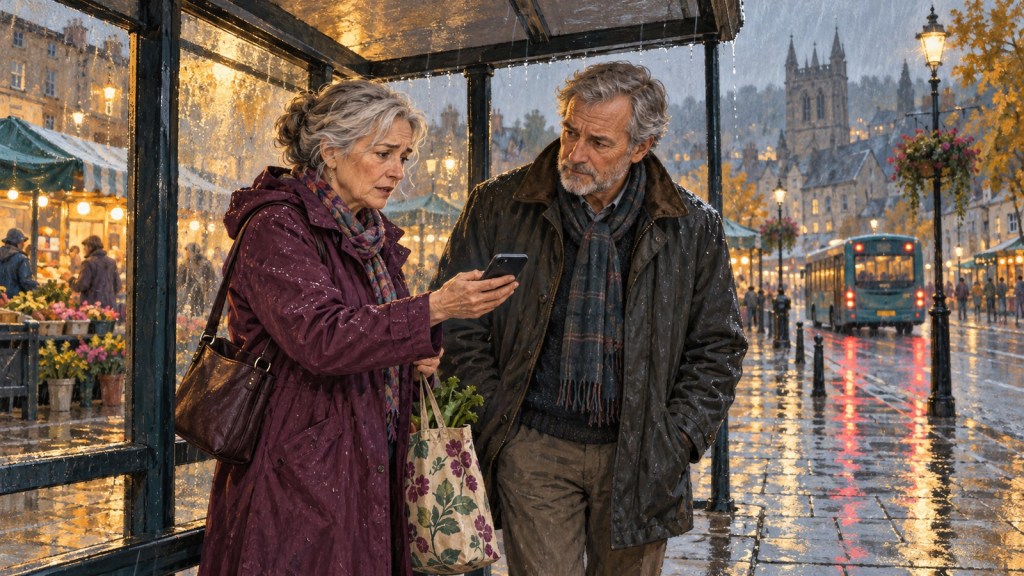
I saw June Maddox before she saw me. She stood beneath the leaking shelter outside Greywoods Market, watching the number sixteen bus pull away without her.
That was unusual. June ran an alterations shop in Bell Street and arranged the final half-hour of each day around that bus. The plum raincoat she wore had been adjusted so precisely that it seemed to stand with her rather than hang from her. A tape measure remained around her neck. In one hand she held a shopping bag; in the other, a phone.
“You’ve missed it,” I said.
She looked at me as if I had offered an unnecessary fact.
“Listen.”
She held out the phone.
A young man said, “Nan.”
The word was followed by a brief catch of breath. Then came a confused account of an accident, a borrowed telephone and money needed at once. He did not want his mother called. She would panic.
June stopped the recording.
The handles of her shopping bag left a red line across her fingers.
“That’s Lewis.”
I didn’t know her grandson well enough to respond. “You think it is.”
Her expression closed.
“It is the moment before he cries. He has done that since he was six.”
I nearly asked to hear it again. The request would have turned her fear into material for my curiosity.
“Have you rung him?”
“It said not to ring anybody.”
“The voice said that.”
June looked down at the banking app open on her screen. Her thumb rested over the amount box.
“Lewis never shields his mother from panic,” she said at last. “If anything, he views it as her natural exercise.”
She closed the app and rang him.
He answered from a laundry room in Newcastle. Three machines had taken his coins, which was the actual crisis. For half a minute he was annoyed with her for worrying. Then June played the recording.
His voice vanished from the small speaker. Neither spoke.
“Nan, I’m sorry.”
“What for?”
“All those foolish videos.”
“Don’t you dare claim this as your fault.”
“But it got—”
“It stole something. You didn’t give it.”
She spoke firmly enough for him. Her hand still gripped the phone when the call ended.
The next bus was twelve minutes away. We went into the market café because June had forgotten the milk and didn’t want to stand under the leak.
We reviewed the bank advice and the police warning. Pause. Check. Call the person on a known number. All sensible. June changed two settings on her phone, then pushed it aside.
“We need one of those family questions.”
“It might help.”
“You nearly said solve.”
“I nearly did.”
She smoothed the cuff of her raincoat, though nothing was wrong with it.
Later, Lewis suggested they ask what he had called the neighbour’s cat when he was four. June said any criminal capable of discovering that deserved the money. They settled on the Christmas pudding that rolled down the cellar steps. The answer made her laugh.
She kept the false recording.
“I can’t delete it,” she told me. “And I can’t listen to it alone.”
When the number sixteen arrived, she boarded. The driver greeted her by name. June replied, then waited a second longer with her pass over the reader, as if even that familiar sound required checking.
In the Meeting House, the rain pressed harder against the window.
Leah had broken a biscuit in two without eating either half.
“Did she stop trusting voice messages?”
“No. She and Lewis still send them. They agreed on the question, though she disliked having to.”
Helen turned her mug between both hands. Her council work card remained in the pocket of her red waterproof behind her chair.
“The advice always sounds simple afterwards,” she said. “Pause and check.”
Tom looked across. “Isn’t it good advice?”
“Yes. Yet fear makes the pause feel risky. If someone might be harmed, stopping can seem like withholding help.”
She glanced at Moira before continuing.
“I can’t discuss cases. Once, a warning sent us to examine something that proved false. It cost time we didn’t have. I was still glad we checked. Another time—”
She stopped and rubbed one thumb along the mug’s rim.
“Another time we nearly assumed the absence of a warning meant nothing was there.”
Nobody asked who or what.
“So which do you trust?” Tom asked.
“Neither on its own.”
Moira nodded. “A pause can be where another person returns to the room.”
Leah looked toward the outline of her phone beneath her coat.
“My daughter sends messages from Canada because she can’t call every time my granddaughter does something. I don’t want to start each one by asking whether it meets a test.”
Her fingers tightened around the broken biscuit.
“A check doesn’t mean you love her less,” Moira said.
“No. But it means doubt arrives with her.”
Bernard cleared his throat. “Where did the copy come from?”
“Lewis had posted short videos,” I said. “They never discovered which were used.”
“So they never found out how it was done?”
“Yes.”
He frowned, dissatisfied with the answer and perhaps with his question. Knowing the source would not have restored the voice to June.
After a while, Ruth gave me a slight turn of her hand. The next story waited across the road from the Gazette office.
The chair at Bell’s
Samira Durrani arrived nineteen minutes late to meet me in the Copper Kettle. She came with rain in her dark hair, a green cardigan visible beneath her coat and a reporter’s notebook she didn’t open.
“At the Gazette,” she said, taking the chair opposite mine, “being late is now the closest thing we have to proof of employment.”
She apologised to the waitress, ordered coffee and placed two printouts between us.
Both concerned the closure of Bell’s bakery. The first was tidy. It listed the opening date, the hours, the 2019 award and the final day of trade.
“Accurate?” I asked.
“Entirely.”
The second was Samira’s version. Two passages had been crossed through in blue.
One concerned bread still left at closing time for the refuge on Napier Road. The other described the wooden chair behind the counter. Albert Bell had first placed it there for his wife during her final illness; afterwards he noticed how many customers needed it and never removed it.
“Martin cut those?”
“The form takes a hundred words.”
“Who decided that?”
Samira clicked her pen once and did not write.
“The owners bought a system that turns council papers, police notices and football results into brief reports. An editor checks them. Fewer staff, more copy. Martin is trying to keep the paper alive.”
She nodded towards the upper floor across the road. Two windows above the Gazette sign were dark.
“Two desks went on Friday. Mine didn’t. ‘Not today’ is the only promise anyone made.”
Her coffee arrived. She wrapped both hands around it without drinking.
“Come on.”
Bell’s bakery was three streets away. The window bore a handwritten notice thanking customers for forty-three years. Inside, the shelves were half empty and the air still carried warm yeast and sugar.
Albert Bell stood behind the counter, large and flour-dusted, one hand pressed against the wood while his other wrist rested. Arthritis had narrowed his movements but not his voice.
“She’ll have told you I’m a pillar of the community,” he said when Samira introduced us properly.
“Not yet,” I said.
“Give her time.”
An older customer walked in, took the chair without asking, and sat while Albert wrapped two loaves. He wiped flour from the edge before handing her the bag.
“That chair belonged to your wife,” Samira said.
Albert’s hand paused on the cloth.
“It was a chair before that.”
“And the bread for Napier Road?”
“Better eaten than counted.”
He glanced at her notebook.
“Don’t make the place seem sacred. The electricity bill closed us, not a decline in public virtue.”
Samira smiled. She liked being corrected when the correction carried more truth.
Back in the café, she wrote Albert’s line beneath the passages Martin had removed.
“Will that be included?” I asked.
“No.”
“Then why record it?”
“Because it happened.”
I looked again at the chair paragraph. It was precisely the kind of detail I valued: ordinary, physical, capable of bearing a whole life without declaring its importance.
Samira noticed my enjoyment.
“Would you keep it within a hundred words, Alex?”
I started to say I would.
“And the bread? And his arthritis? And the children who don’t want the shop? And the editor trying to save the paper?”
“No.”
“That is the work: not including everything, but knowing what it costs when you leave something out.”
The report appeared online that afternoon. Mr Bell closed the following week. The facts were accurate, and Greywoods knew less.
When I told the Meeting House this, Bernard leaned forward.
“That sounds like poor management.”
Tom turned his mug once between his hands. “If the system keeps the paper open, refusing it isn’t a simple virtue.”
“No,” Bernard said. “I may be blaming the wrong part.”
“Or only one part,” Ruth said.
Frances reached into her canvas bag and pulled out three stapled pages covered in blue ink.
“I used one of these last month.”
Every face turned toward her. She disliked becoming an exhibit, which may explain why she continued.
“A report for a Meeting committee: too long, repetitive, written by six people in four styles. I asked it to shorten the text.”
“Did it?” Bernard asked.
“Beautifully.”
She found a marked paragraph.
“It removed this sentence: ‘Two Friends remained uneasy that the saving might fall on the people least able to challenge it.’ Awkward sentence. Important fact.”
“Did the machine decide it was unimportant?” Tom asked.
“I asked for brevity. It supplied it.”
“Then you put the sentence back.”
“Yes. We used the shorter report.”
Tom spread his hands. “So checking worked.”
Frances looked at him over the paper.
“Because I knew the disagreement was there. Suppose I hadn’t been in the room?”
No one answered.
I said, “A thin answer becomes cheap, quick and easy to repeat.”
It was a neat sentence. I heard the neatness as soon as it left me.
Samira was still at her desk, covering more streets in less time. Martin was still cutting work he valued. Albert no longer rose before dawn. I had arranged their losses into a sentence fit for a fireside.
The notes under my chair seemed heavier.
“Samira would tell me I had left out the price of the coffee,” I said.
Frances smiled. “And she would be right.”
Ruth wrote beneath Questions:
**Who chooses what survives?**
Moira had gone to check the back door. She returned with the walking stick she had left by the umbrella stand and lowered herself into her chair.
“Losing work is dreadful,” she said. “But it isn’t the thing that frightens me most.”
“What is?” Ruth asked.
Moira rested both hands on the stick.
“An answer you cannot answer back.”
Ruth’s pencil stopped.
I knew which story had to come next.
Continue reading: Part 2 — Answers
Author’s note. I conceived and directed this story and developed it with sustained AI assistance. AI provided substantial help with research, drafting, revision (including bringing the characters’ feelings, motives and relationships onto the page) and quality control. I selected, tested and approved the published text. I take responsibility for it.


Leave a Reply