
Roland Carn
A green band says Peter can go home. He knows something the score does not.
Part 2 of 4
Peter’s green band
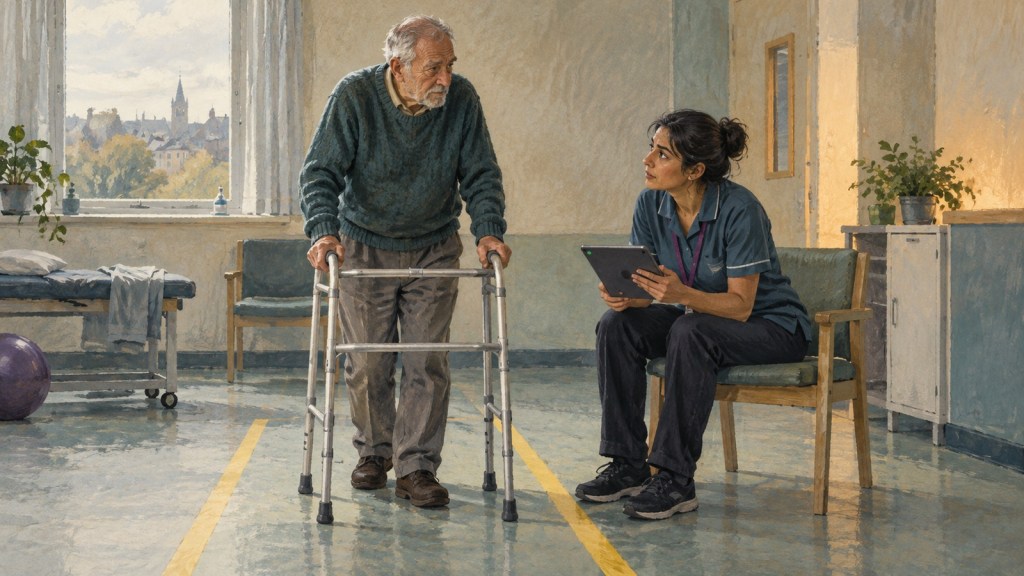
Peter Vale told me the story in the rehabilitation unit while a walking frame waited between two yellow lines on the floor.
He had been a railway signalman. He trusted systems when a signal referred to a real condition and someone could trace what had happened. Hospital language annoyed him partly because its signals did not stay still.
“I had broken my hip,” he said. “Not my mind.”
He pronounced every word with care. Both hands lay flat on his knees.
“You sound annoyed.”
“I was annoyed. I did not dare show it there. Anger from an older man can be interpreted in more than one way.”
After the operation, Asha Reed arrived to discuss discharge. Peter recalled the ward’s heat, trolley wheels catching a joint in the floor, and the curtain that concealed him without offering privacy.
“She wasn’t unkind,” he said. “Include that if you recount it.”
“I will.”
Asha had several cases open on the screen. She reviewed his record and asked whether he managed his own meals, washing, and medicines.
Peter said yes.
“Mostly?” I asked.
He glanced toward the walking frame.
“Joan handled some tasks before she died.”
“Which tasks?”
“The ones that now appear more extensive than I realised.”
A green band appeared beside his name: suitable for home, with two visits a day.
Peter told Asha that the bathroom was upstairs, the front step was high, and the outside handrail had pulled away from the brick.
“Not the stair rail,” he told me. “People kept mentioning stairs. The front step was the immediate problem.”
Asha turned the monitor slightly away.
“Why?” I asked.
“You tell me.”
I could not. It might have been habit, privacy, or protection from a result she had not finished reading.
She said the model placed him in a low-risk group.
“I wanted to ask what would happen if it was wrong,” Peter said. “I also wanted to go home. I did not want them deciding that knowing my high front step proved I couldn’t manage it.”
So he heard himself agree with a colour.
His daughter Caroline did not. She managed a dental practice seventy miles away and knew how to turn concern into calls, names, and times. Peter described her intervention as though it were an outbreak of weather.
“She rang everyone.”
“Did that annoy you?”
“Of course.”
“Did it help?”
“That is a separate question.”
Marjorie Pike, his neighbour, went into the house with the garden key Joan had given her years earlier. She took photos of the front step, loose rail, stairs, bathroom and the rug Peter had not mentioned; her thumb obscured part of two images.
When Caroline showed them to Asha, Asha enlarged each shot and posed additional questions. She did not laugh at the thumb, but she altered the plan.
Peter attended rehabilitation. The handrail was fixed, and Caroline purchased a second rail for the stairs, which Peter called excessive until he used both.
“Marjorie’s thumb carried more weight than my words,” he said.
His frame landed, lifted and landed between the yellow lines as he walked away from me.
At the far end, he turned.
“I had Caroline. I had Marjorie. What happens to the person who doesn’t fit the score and has nobody to prove it?”
In the Meeting House, Ruth asked, “Was it AI?”
“I heard it called an algorithm, a model and decision support. Peter did not care what it was called; he feared the weight given to its answer.”
Priya had come directly from Greywoods Royal Infirmary. Part of her dark hair had slipped from its knot. She had held the same cup since June’s story, and the tea inside must have been cold.
“A warning once made me look again,” she said. “I found what I had missed.”
Moira turned toward her but did not interrupt.
“One night, there was no warning. I nearly accepted that as reassurance.” Priya looked down into her cup. “It wasn’t reassurance. It was only no warning.”
“Then neither the person nor the warning gets to disappear,” Moira said.
“No.”
“But one of them appears in a coloured box.”
Priya met her eyes. “Yes.”
“If the alert’s wrong and I follow it, that can harm someone,” she said. “If it’s right and I dismiss it because alerts are often wrong, that can harm someone too. The system doesn’t go home with either choice.”
Helen lowered her gaze to the work card in her coat pocket.
“In my work, a rating can indicate where to focus first,” she said. “The difficulty comes when first becomes only.”
Ruth saw Peter’s question in my expression, or perhaps her own future within it.
“Who is allowed to challenge the result?”
Priya warmed her hands around the cold cup.
“There must be someone,” she said. “And enough time for them to listen.”
“Must be is not identical to is,” Moira replied.
They allowed both statements to stand.
Colin had the chair closest to the door. He had remained quiet, watching the fire and, occasionally, the dark window.
“Sometimes,” he said, “you cannot even determine whether an answer existed.”
Ruth didn’t need to signal. The next story had already started.
Ellis beneath the camera
I had gone to return a library book and found the precinct crowded with umbrellas, placards and the tinny sound of a portable loudspeaker.
Greywoods Homes for All was protesting a round of no-fault evictions. At the edge of the crowd, a young man distributed leaflets. He wore a grey hooded top, although the rain had ceased and the afternoon was mild for March.
The unit on a police van roof turned toward the square.
He pulled up his hood.
“That makes you appear suspicious,” the young woman beside him said.
He pushed it back. For a few seconds he held his placard above his head. The camera shifted again. The placard came down and the hood went up.
I took out my phone. I intended to photograph the equipment so I could research it later.
The young man noticed the phone before I used it.
“Are you press?”
“No.”
He waited.
I raised the library book as if *The Buildings of Greywoods* clarified my presence.
“I was going to take a picture of the camera.”
“With me beneath it?”
I put the phone away.
He was Ellis Grant. He studied urban planning and had joined the campaign after his family spent several years moving through insecure rented homes. Maya Brooks, beside him, studied law and believed that retreat gave surveillance more power.
“We came here to be seen,” she said.
“By people,” Ellis replied.
At the time, I still assumed the issue was what the equipment might achieve.
People in the crowd searched their phones. We located police policy, reports from other cities, campaign claims and a page detailing how to complain. The pages outlined what such equipment could do, what certain forces were permitted to do and how data ought to be managed. None explained what that unit was doing in Greywoods that afternoon.
Stephen Hall, the march steward, approached a young police officer. His fluorescent vest made his role obvious in a way Ellis’s clothes didn’t.
“Can you tell us whether the camera’s identifying people?” he asked.
The officer’s name badge read Fletcher. She looked at the van, then at the crowd. A body-worn camera rested on her jacket.
“The police privacy information is on the website.”
“I’ve read the website. Is this unit recording faces?”
“I don’t operate the equipment.”
“Who can tell us?”
Her radio spoke before she could answer. She listened, replied and directed Stephen towards the public enquiries address.
It was not an answer. It was also possible she had no better one.
The march began. Ellis stood at the edge, hood up, sweating beneath it. When the crowd called, “Homes are for living,” he joined on the second line rather than the first.
Maya moved beside him and raised her placard. She did not ask him to uncover again.
Nobody was arrested. The march was peaceful. Two people stepped away from a television camera. Ellis stayed.
“Did you find out afterwards?” he asked me when people began to leave.
“I found more pages.”
“That isn’t what I asked.”
“No.”
He pushed back the hood. His hair was damp with sweat.
“I have an assignment due at midnight,” he said, almost laughing. “I came here to tell the council not to make decisions about people it hasn’t met. Now I’m going home to write about public participation.”
Maya touched his shoulder with the edge of her placard.
“Put that in.”
“I might.”
He glanced again toward the van.
“Don’t include my face.”
In the Meeting House, Colin asked, “Did the police camera capture him?”
“I don’t know.”
“Did it use face recognition?”
“I don’t know.”
“Did they keep anything?”
“I couldn’t confirm that either.”
He leaned back. “Yes. That’s it.”
I had composed a sentence while recounting the story: surveillance can direct people by prompting them to picture the observer. It was accurate. It was also no longer mine to use.
Colin looked toward the curtained window, though only the Meeting House garden lay beyond it.
“There are other paths into the market place,” he said.
Nobody replied.
“I am taking one now.”
His hands rested still between his knees.
Bernard asked, quite gently, “Because of the cameras?”
“Because I don’t know what they do.”
He described, in measured parts, raising concerns about council repair contracts two decades earlier. No inquiry had identified a crime. Nobody had formally disciplined him. His work had simply ceased moving toward anything.
“I can’t prove the record followed me,” he said. “That is the point.”
Helen turned her cold cup between her hands.
“Not knowing doesn’t confirm the worst is occurring.”
Colin nodded once.
“But you still must choose your route,” she said.
He looked at her then.
“Yes.”
Leah was rotating her ring.
“Even a common image can be made to convey something different,” she said. “Keep the image and lose why the person was there.”
Colin’s shoulders tightened.
“I didn’t say anyone had done that.”
“No,” Leah said. “You didn’t.”
She allowed the correction to stand.
I struck a line through the sentence in my notebook.
“What would assist?” I asked Colin. “Not resolve it. Assist.”
Helen picked up the precinct leaflet from the floor between their chairs.
“We could make the question precise: what was recorded, what was analysed, what was kept, who can receive it and how someone can challenge it.”
“We?” Colin asked.
“Only if you wish.”
He considered the leaflet, then accepted it back. “I want to decide what I am asking.”
“Quite right.”
Ruth found a clean sheet of paper. Bernard provided a penknife when the pencil snapped, and Ruth remarked that this was not the time to sharpen a pencil with a blade. He did so anyway, above the biscuit plate.
They composed five questions. Colin took the page but did not tuck it into his pocket.
“I’ll think about sending it.”
At that point, the security light turned on in the garden. Every face shifted toward the window.
Nothing stirred outside.
I was about to tell them about a picture that had made me laugh. Then I remembered what Daniel had almost made next.
Continue reading: Part 3 — Making
Author’s note. I conceived and directed this story and developed it with sustained AI assistance. AI provided substantial help with research, drafting, revision (including bringing the characters’ feelings, motives and relationships onto the page) and quality control. I selected, tested and approved the published text. I take responsibility for it.


Leave a Reply