
Roland Carn
A picture takes seconds to make. A letter can sound more employable than the person who wrote it.
Part 3 of 4
What Daniel nearly made
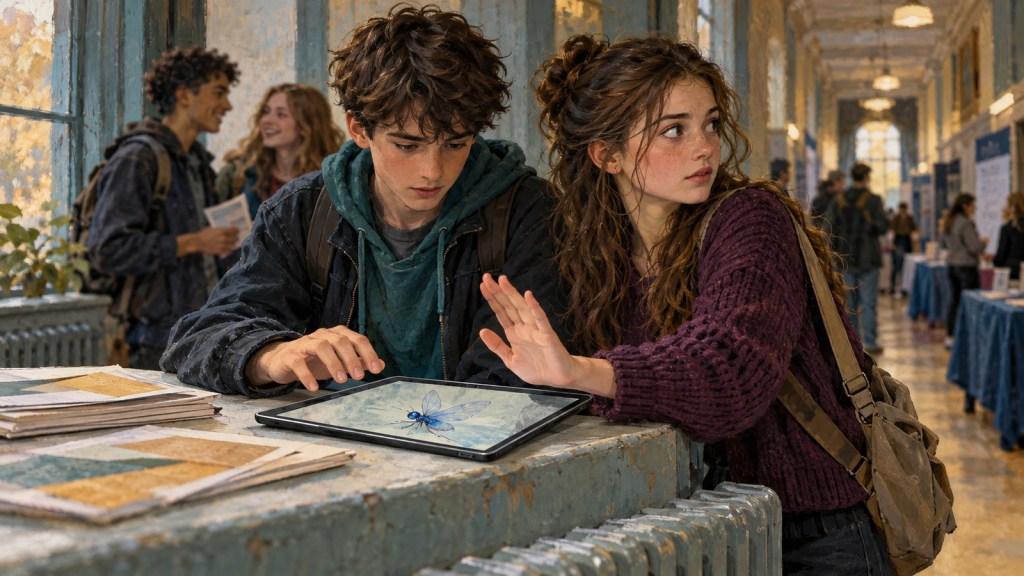
Greywoods Sixth Form held its careers afternoon in a hall that smelled of floor polish, warm plastic, and chips. I was supposed to assist at the adult-learning table. I had been handed a stack of leaflets and a chair under a banner peeling from the wall.
Laughter drifted from a side corridor where the wireless signal was stronger, and adults were fewer.
Daniel Okoro sat on a radiator ledge with three friends gathered around his tablet. On the screen, the head teacher wore a silver cape beside a helicopter while the science block burned behind him.
“Twenty seconds,” Daniel said.
The image was absurd and brightly lit. I laughed, before remembering I was one of the adults.
“You aren’t going to tell him?” Daniel asked.
“I haven’t yet decided whether to ask for a copy.”
That gained me a small place within the circle.
Nadiya Khan stood behind Daniel’s shoulder. “Do Mr Parry getting arrested.”
Daniel began typing: history teacher, school gates, two police officers, documentary photograph—
“Don’t.”
His fingers hovered above the screen.
Nadiya looked not at the tablet but along the corridor, to where Mr Parry was speaking to a parent by a poster about evidence-based careers.
“What?” Daniel said.
“Don’t make it.”
One of the others laughed. “Everyone knows it’s fake.”
“We know.” Nadiya pointed toward the hall. “My mum wouldn’t.”
Daniel looked at the waiting prompt, then at his friends, and only then at her.
“I can label it.”
“Labels get cut off.”
“It would look ridiculous.”
“So did the head.”
They all turned toward the first image, already posted to the group chat. A reply indicated that someone outside the corridor had forwarded it.
Daniel deleted the unfinished prompt in one motion and opened another file, as if pausing had cost nothing.
“Make the insect,” Nadiya said.
He produced a blue creature with transparent wings and the feet of a small dog. Nadiya called the legs disgusting. The group laughed again, yet the arrest stayed in the corridor precisely because no image of it existed.
Later I found Daniel at the edge of the hall adding shadows to the insect.
“What changed?” I asked.
“Nadiya said don’t.”
“You usually obey at once?”
He grinned. “Obviously.”
The grin faded. He continued drawing.
“Everyone talks about fake pictures making people believe things,” he said. “But if you can make a picture of anything, someone shown doing something real can claim it’s fake.”
I’d arrived at the careers afternoon ready to be an older person offering useful cautions. Daniel gave me the sharper account.
“So what will you do?”
“No real person without permission.”
“Will that solve it?”
He looked at me then, openly impatient.
“No. It’s what I can do.”
Mr Parry passed us carrying a stack of exercise books.
“Harland,” he said to me, with the patient disappointment Daniel had captured perfectly. “Your table appears to be unattended.”
“Career exploration.”
“Naturally.”
Daniel waited until he was out of hearing.
“Permission would ruin that one.”
He kept making imaginary creatures. The head-teacher image kept travelling.
In the Meeting House, Leah said, “His rule won’t save the world.”
“No.”
She seemed almost disappointed that I had not brought a defence.
Owen turned his notebook toward his chest.
Ruth noticed. “Would you like us to see it?”
He considered this before laying the book on the floor inside the circle. He had sketched June’s phone, the police camera and Daniel’s tablet as three dark forms. A line linked them but halted before completing a triangle.
“They all take something away from a person,” Owen said. “Then it moves somewhere the person cannot quite follow.”
Tom leaned forward to examine the sketch. “You use image generators.”
“Yes.”
“But you object to them.”
“Yes.”
“That is convenient.”
Owen’s face flushed. He opened his phone and displayed a luminous bird with six wings, then a row of strange architectural animals.
He handed the phone to Bernard.
“Seven,” Bernard said.
Owen counted the bird’s wings again. One had faded into the sky. He laughed.
“I like what happens when it fails,” he said. “I like being surprised. I don’t like people claiming it made the picture from nothing. And I do not like speed being treated as the same thing as imagination.”
Frances moved closer to the drawing. “What has vanished from the copy?”
“The people whose work taught it how things look.”
Leah tapped the page beside the unfinished line.
“Daniel’s rule still isn’t enough.”
“No,” Owen said. “But Nadiya was allowed to change her mind, and Daniel stopped. That isn’t nothing because it isn’t everything.”
Bernard rose to refill the kettle. Ruth knew he often made tea when a feeling came too close and didn’t stop him. Cups moved through the circle. Priya took fresh tea and held it for warmth. Tom answered a message, frowned and placed his phone face down.
Frances watched him.
“That brings us to words,” she said.
The man who sounded employed
Abdul Rahman stayed behind after the evening writing class at Greywoods Adult College. Outside, buses carried cleaners, shop workers and students home. Inside, the fluorescent lights hummed above scratched tables, and the heating had turned itself off at nine.
Abdul placed a pack of chips between us and spread two application letters beside it.
“Which man gets the training place?”
The first letter showed crossings-out, spelling edits and three tries at the opening line. It described a Friday night at the takeaway when four delivery riders arrived together, the card reader failed, and chips began to burn.
The second applicant claimed a “proven capacity to leverage transferable competencies in a dynamic operational environment”.
“What did he do?” I asked.
“He leveraged.”
“Before that.”
Abdul pushed the first letter toward me.
He had separated the orders, restarted the reader, kept waiting customers informed and stopped the oil smoking. He had done this while the manager was away and his mother was calling because a prescription had not arrived.
“That man sounds capable.”
“That man sounds like he burns chips.” Abdul tapped the polished letter. “This one sounds employed.”
I laughed, then realised he was not simply joking.
“Did you understand all of this?”
“Enough to know he is better than me.”
“He isn’t you.”
Abdul’s shoulders rose.
“Use my own voice?”
I heard the phrase I had been about to suggest.
“Something like that.”
“Has your voice ever cost you a job?”
The heating clicked in the pipe and failed to start.
“Not in the way you mean.”
“If I send mine, they see mistakes before they see me. If I send this one, they see a man I have to become when I arrive.”
We opened the training provider’s website. Applications must be the applicant’s own work. The form corrected spelling as a person typed. A help page praised clear communication and said nothing about where help ended.
I wanted to edit the rough letter. I could see six changes before finishing the first paragraph. That urge was not entirely generous. A clean sentence gives me pleasure.
Abdul watched my pen.
I put it down.
“What do you want the machine to do?”
“Get me the interview.”
“And what do you want to do?”
“The job.”
We began again. This time he asked the system to highlight passages a reader might find unclear without altering them. It marked too many. Abdul rejected half the suggestions; where he agreed, he described the event aloud and drafted the new sentence himself.
At half past ten, the burning chips remained.
“Keep them?” I asked.
“Of course. I saved them.”
Three weeks later, he entered the classroom carrying another parcel.
“For the employed man,” he said.
He had been offered the position.
For several minutes, neither of us acknowledged the success. We ate the chips while they were hot.
Only then did Abdul mention that his mother had told every customer at the takeaway and was now concerned about who would collect her tablets on his training nights. He was proud, pleased and already addressing the next issue.
In the Meeting House, news of his success produced the warmest sound of the evening.
Tom cleared his throat.
“I use AI for customer replies. If I don’t, messages wait until midnight.”
Frances turned toward him. Tom sat forward as if expecting judgement.
“Do the replies convey what you mean?” she asked.
“Usually.”
“Would you stand by them if the customer came through the door?”
His phone lit beneath his hand. He read the draft on the screen.
“It says we can repair any electric drive within forty-eight hours.”
Bernard looked over. “Can you?”
“No.”
“Then artificial intelligence has exceeded the known powers of Greywoods Cycle Works.”
Tom deleted a sentence with his thumb.
“That’s a better test,” he said to Frances. “Not whether I typed it. Whether I’ll say it when they’re standing in front of me.”
“That sounds like integrity,” George said.
Tom glanced at him. “It sounds like avoiding an argument with an angry cyclist.”
“The two may sometimes coincide.”
Frances laughed. “I may have been treating struggle as though it always improves writing. Sometimes it merely keeps somebody outside the gate.”
“And sometimes polish sends somebody else in his place,” Moira said.
I nearly proposed Abdul’s approach as our response. Then I noticed Samira’s pen clicking above the two vacant desks. A boundary that aided one person in finding words did not restore another’s work.
“It worked for Abdul,” I said. “In that task.”
Ruth wrote:
Which words will I answer for?
George set the grandad mug gently on the floor.
“You have mentioned families, newspapers, hospitals, police, schools and work,” he said. “What occurs when pressure acts between states?”
No one reached for the kettle.
“What occurs when the greatest fear is that someone else will move first?”
Continue reading: Part 4 — The Nearest Answer
Author’s note. I conceived and directed this story and developed it with sustained AI assistance. AI provided substantial help with research, drafting, revision (including bringing the characters’ feelings, motives and relationships onto the page) and quality control. I selected, tested and approved the published text. I take responsibility for it.


Leave a Reply