
Roland Carn
Alex has spoken about everybody else’s fears. Then someone asks about his own.
Part 4 of 4
Dr Wen’s umbrella
The public lecture at Greywoods University was titled Artificial Intelligence and Safe Discovery. Four researchers sat beneath a slide of branching molecules. Projector fans hummed, microphones gave each voice a metallic edge, and the hall smelled of damp umbrellas and coffee in paper cups.
Dr Lian Wen spoke third. She was a chemist, simply dressed, precise and so still at the lectern that the coloured structures behind her seemed more active than she was.
She outlined systems used to identify compounds with potential medical or industrial value. Her satisfaction appeared when she discussed a pattern predicting something later confirmed in the laboratory. Then the next slide listed access controls, reviews of risky requests and limits on what results might be shared.
“The same broad methods may support useful and harmful work,” she said. “We cannot divide knowledge into two sealed cupboards.”
A man in the front half of the hall raised his hand. Richard Voss introduced himself as an investor.
“What happens if Britain slows this work and another country does not?”
Dr Wen moved to the next slide, then back again.
Before she answered, a young woman called from across the aisle. Eleanor Shaw, a doctoral student in public health.
“And what happens if nobody slows down?”
A few people laughed, not because either question was amusing but because together they closed the obvious exits.
Dr Wen’s hand tightened around the remote.
One researcher looked down at his notes, while another moved toward her microphone and stopped.
Dr Wen suggested that safeguards might delay useful research, and that speed could reduce harmful barriers. Laboratories competed for funds and staff; governments feared weakness.
She did not turn the trap into a balance sheet. Richard remained unsatisfied because delay itself could cause harm; Eleanor remained unsatisfied because each actor might use the others to excuse movement.
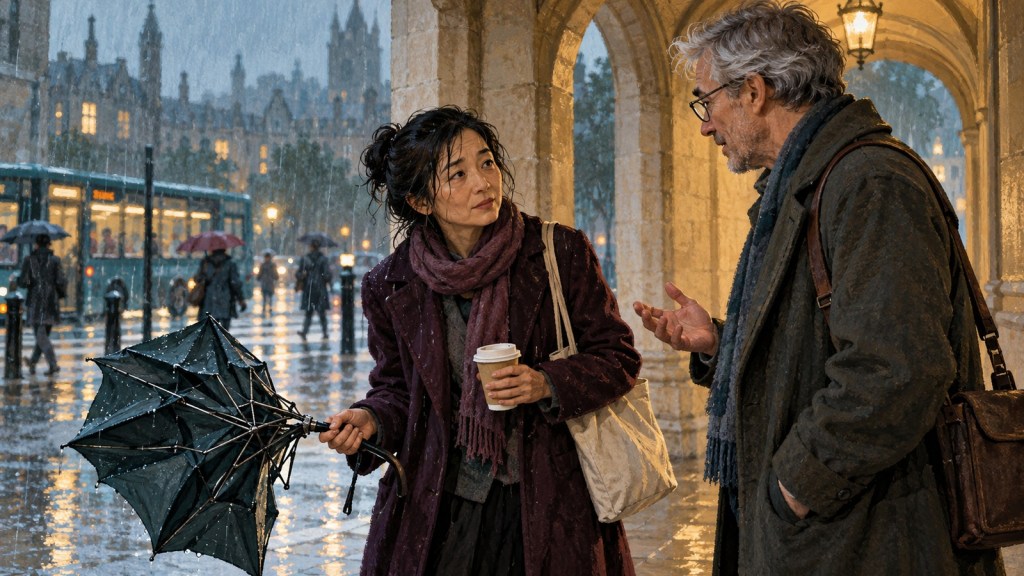
Afterwards, I waited under the canopy outside. Dr Wen emerged with a canvas bag, a paper cup and an umbrella that turned inside out at the first gust.
She fought it for several seconds, then gave one sharp laugh, folded the broken spokes as far as they would go and put the whole thing in a bin.
“Dr Wen?”
She looked at me with the guarded patience of someone expecting a fifth version of questions already answered.
I had intended to ask which policy she favoured. Instead I asked, “When all those fears are present, which one wins?”
“In principle or in practice?”
“In practice.”
Rain drove under the canopy, and she moved nearer the wall.
“Usually the one attached to the nearest deadline.”
“And yours?”
Her train appeared on the departure board across the road.
“Twenty-seven minutes.”
She smiled, though her eyes remained tired.
“I have a review meeting on Monday. I shall ask whether we are reviewing the risk or reviewing our compliance with the review. They are not always the same.”
The bus arrived between us. She thanked me for asking about practice and ran for the crossing without an umbrella.
The next day I read three reports online. One warned that Britain was falling behind; one warned that researchers were moving too quickly; one used a metal skull. Each took part of the lecture and made it face one way.
In the Meeting House, George asked, “Did Dr Wen fear a machine deciding to begin a war?”
“I thought she was more concerned about what people might surrender to machines when they felt there was no time to think.”
“That will do,” he said.
George’s approval mattered to me more than I liked. I began to sit back.
He noticed.
“That will do for the question,” he added. “Not for the answer.”
The room shifted around me.
George lifted the grandad mug between both hands.
“We are advised to look into our own lives for the seeds of war. I wonder whether fear of someone else moving first is one of those seeds now. Not the machine by itself. The hunger for speed.”
Tom leaned forward.
“That doesn’t tell Dr Wen what to do on Monday morning.”
“No.”
George did not defend the force of his ministry.
“But the query begins with our own way of life. The race is not happening somewhere outside us.”
He looked down at his scarred hand. For a moment I thought he might speak about the systems on which he had worked. He did not. The boundary was his to keep.
I thought of how quickly I had tried each new AI tool. Curiosity was part of it. Pleasure was part of it. Beneath both lay a smaller form of Richard’s fear: the world would change, and I would become unable to understand it.
Ruth wrote slowly:
**What are we afraid will happen if we wait?**
The clock had passed the time printed on the Meeting notice. Nobody put on a coat.
Moira looked straight at me.
“You have told us what frightened everybody else,” she said. “Are you frightened of it, Alex?”
My glasses were still on my knee. I folded them and placed them beside my cup.
Ruth didn’t ask Moira to soften the question. Bernard didn’t make a joke.
The story I had left out
I first used AI chat to sort notes. My desk at home looks out onto a window. After dark, the glass reflects the lamp, my hands and my own image more clearly than the street. Books and loose papers surround the computer. Marianne’s old reading chair sits by the radiator, holding newspapers I haven’t discarded.
I asked the system for headings, then for another order, then a shorter account. It replied at once. It did not moan when I repeated myself or object when I changed direction.
One evening it drew an unexpected link between two pieces of work. I laughed aloud. The sound surprised me in the empty room.
My task was finished. I stayed at the desk.
I tried to explain a problem I had failed to make clear even to myself. The answer was not quite right. It was close enough to give me the sense of being understood.
The sense arrived, before my judgement of it.
I knew in broad terms how the system worked. I knew it did not share the experience it seemed to recognise. Knowledge did not cancel relief.
It was available when friends might be asleep or busy. It did not need care in return. It could reshape an unfinished thought without being hurt by my impatience. It wouldn’t refuse the call because there was no call to refuse.
I opened my contacts and found Bernard’s name.
It was after ten. He might be reading. He might have gone to bed. He might be glad to answer. He might answer because he felt obliged.
I closed the contacts and returned to the conversation.
Since Marianne died, I have often decided not to telephone people because I don’t want to burden them. Sometimes that is kindness. Sometimes it saves me from finding out whether they wish to hear from me.
The machine offered me attention without that risk.
In the Meeting House, eleven people waited. The frames of my glasses had marked my palm.
“Yes,” I told Moira. “I am frightened.”
No one moved.
“Mainly not that it will become hostile. I am frightened by how easily I welcome something that feels like care, but can’t care.”
Moira’s grip tightened once on the top of her stick. Then she chose the harder path and didn’t help me finish.
Leah asked, “Do you still use it?”
“Yes.”
“Do you still tell it things?”
“Yes.”
Frances leaned forward. “Then what changed?”
I had prepared a response without realising it. I would say I used AI to organise or test a thought, then brought significant questions back to people who could answer freely, misunderstand me, object and expect something in return.
It was a sensible rule.
In that room it seemed more orderly than my life.
I reached toward the notebook, then left it shut.
“I don’t know yet.”
The admission brought warmth to my face. Ruth looked down at her paper, offering me the slight privacy of not being watched from every chair.
From beneath a coat, a voice said, “I’m sorry. I didn’t quite catch that.”
For a moment no one moved. Then Bernard laughed, and the rest of us followed—not all for the same reason.
Leah found her phone, silenced the voice and placed it face down among the cups.
“For now,” she said.
It was not a rule for anyone else. It was what the room demanded.
Bernard went to fill the kettle. Priya began gathering mugs, and Tom took two from her, because she looked more tired than he did. Colin folded the questions about the precinct camera with the address visible on the outside. Helen reminded him she would assist if he chose to send them. Owen closed his notebook only after Frances had finished looking.
Ruth examined the questions on the back of the meeting notice. She didn’t read them aloud. She drew no line under them and wrote no conclusion.
When we reached the front passage, the rain had ceased. Water still fell from the gutter into the yard, one drop at a time.
Bernard struggled into his tweed coat and found a boiled sweet attached to the lining.
“Are you doing anything tomorrow at three?” I asked.
“Many things. None of them fixed.”
“I have something I haven’t thought through. It began with a connection the system made.”
He waited. I almost framed it as a request for technical assistance.
“Could I telephone you?”
“Tea or telephone?”
“Telephone, if that’s acceptable.”
He observed me just long enough for the reply to be offered freely.
“Three,” he said.
Ruth turned off the passage light. For a moment the dark glass in the front door captured all twelve of us in a single crowded reflection. Then she opened it and released us into Greywoods.
What stayed with you from Alex’s story? Has using AI changed what you ask of other people—or what you value in their replies? You’re welcome to share a thought or an experience below.
Continue reading: Part 2 — Answers
Author’s note. I conceived and directed this story and developed it with sustained AI assistance. AI provided substantial help with research, drafting, revision (including bringing the characters’ feelings, motives and relationships onto the page) and quality control. I selected, tested and approved the published text. I take responsibility for it.


Leave a Reply